← All BooksKorean

Book Sets & Course Plans

Physical AI with RoboCo · CORE-01

CORE-01MOVE / CONTROLPhysical AI with RoboCo

Physical AI with RoboCo · six-book series

Pick books by goal,
plan classes by level

This page shows how to combine the six books for different goals, with sample schedules for elementary, middle, and high school, college, and adult learners. Anything that includes CORE-01 is highlighted.

Each book runs on its own robot files, start file, and library. The combinations below are recommended connections by goal, not prerequisites.

The six books

CORE-01 ↔ QUAD-01, CORE-02 ↔ QUAD-02, and CORE-03 ↔ QUAD-03 cover matching concepts, so the tracks can also be read side by side.

Book sets by goal

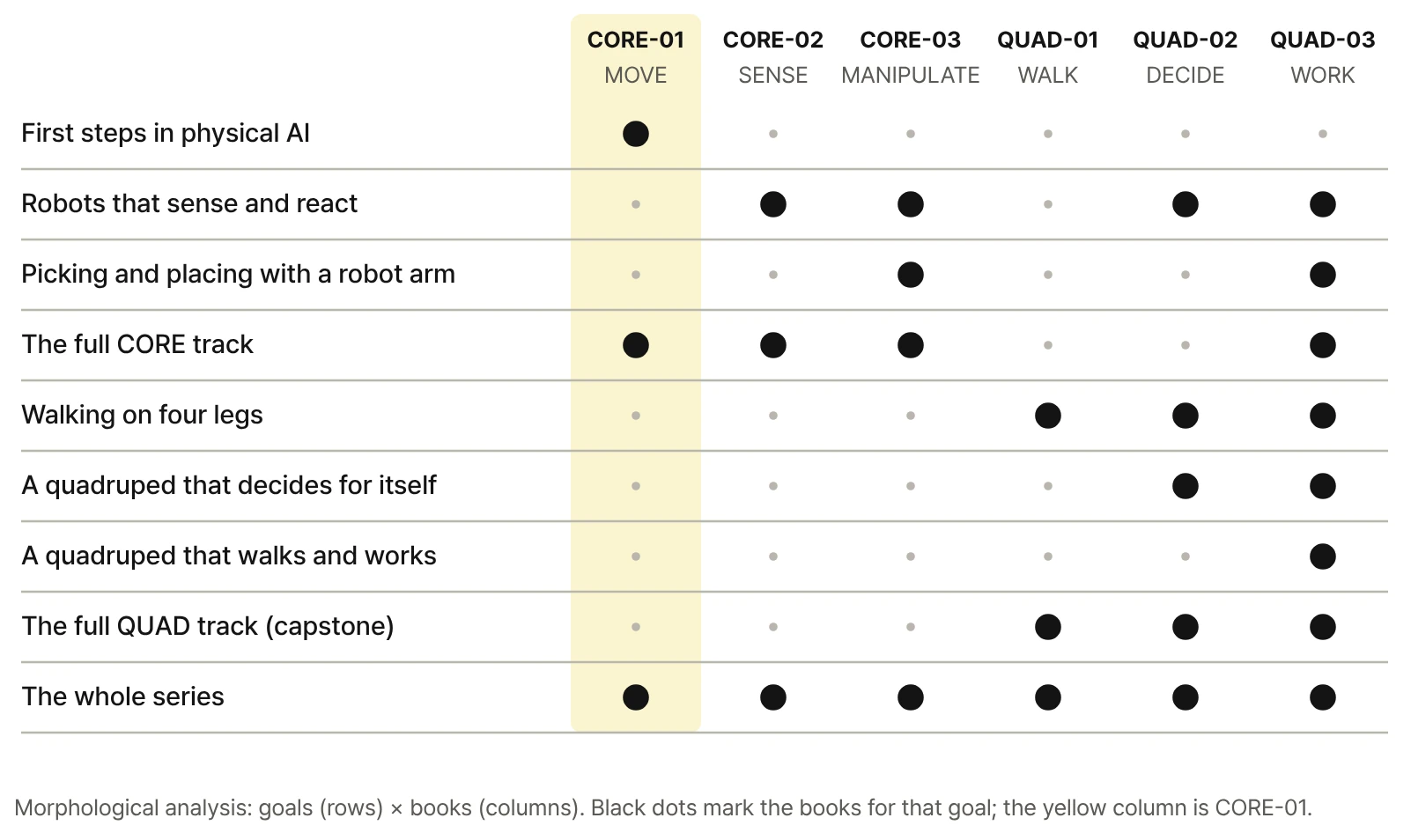
A matrix of nine goals (rows) by the six books (columns). Black dots mark the books for each goal; the CORE-01 column is highlighted in yellow.
Morphological analysis Goals by book. Find your goal's row and pick the books marked with a dot.Enlarge ↗ (Open full size in a new tab)
GoalBooksFlowBest for
First steps in physical AICORE-01MOVEElementary to high school, adults
Robots that sense and reactCORE-02 + CORE-03 + QUAD-02 + QUAD-03SENSE → MANIPULATE · DECIDE → WORKAdvanced middle and high school, college
Picking and placing with a robot armCORE-03 + QUAD-03MANIPULATE → WORKHigh school, college, makers
The full CORE trackCORE-01 + CORE-02 + CORE-03 + QUAD-03MOVE → SENSE → MANIPULATE → WORKHigh school clubs, intro college courses
Walking on four legsQUAD-01 + QUAD-02 + QUAD-03WALK → DECIDE → WORKHigh school, college, makers
A quadruped that decides for itselfQUAD-02 + QUAD-03DECIDE → WORKCollege, advanced high school
A quadruped that walks and worksQUAD-03WORKCollege, makers
The full QUAD track (capstone)QUAD-01 + QUAD-02 + QUAD-03WALK → DECIDE → WORKCollege capstone
The whole seriesCORE-01 + CORE-02 + CORE-03 + QUAD-01 + QUAD-02 + QUAD-03MOVE → SENSE → MANIPULATE · WALK → DECIDE → WORKYear-long institutional programs

Grayed-out books aren't out yet. Until they are, start with the published ones.

Course plans by level

These schedules are suggestions; merge or split sessions to fit your hours and learners. Each student computer needs its own copy of RoboCo from Steam.

Elementary school (upper grades)

FormatAfter-school or camp · 8 sessions × 40 min · driving and observing (the teacher runs the code)
BooksCORE-01
OutcomeA hand-driven guide mission and an observation sheet
UnitActivityBook scope
1Meet RoboCo and physical AICORE-01 Getting Started
2Drive the four-wheel robot with the keyboardCH01
3Same key, different path — the script robotCH02
4Exploring slopes and ledgesCH03
5Reading the robot's state from the screen and LEDCH04
6Observing the eight motionsCH10 figure · web video
7First guide mission (hand-driven)CH05
8Presentation — where it failed and what we changedCH25 video

Middle school

FormatElective or club · 12 sessions × 45 min
BooksCORE-01
OutcomeA script-run guide mission and one single-variable experiment record
UnitActivityBook scope
1Setup and first driveGetting Started · CH01
2Running the same keys on the script robotCH02
3Speed, terrain, and status displayCH03–04
4First guide missionCH05
5Finding motors, servos, and PortsCH06–07
6Two paths of the W key and wheel combinationsCH08–10
7Changing values in the start fileCH11
8Reading key input and the four-motor groupCH12–13
9Changing one value at a timeCH16–17
10Stopping and comparing two control methodsCH19–20
11Designing the mission route and statesCH21–23
12Final mission and presentationCH24–25

High school

FormatComputer science/AI class or club · one semester, 16 weeks × 2 periods
BooksCORE-01 + QUAD-01
OutcomeA four-wheel guide-mission report and a quadruped walking result
UnitActivityBook scope
1Setup and first driveCORE-01 Getting Started · CH01–02
2Speed, terrain, status, first missionCORE-01 CH03–05
3Motors, servos, Ports, control pathsCORE-01 CH06–08
4Commands vs. motion, wheel combinationsCORE-01 CH09–10
5Start file, input, motor groupingCORE-01 CH11–13
6Servo ranges and reading the LOGCORE-01 CH14–15
7Single-variable experiments and reportCORE-01 PART 4
8Four-wheel final mission presentationCORE-01 PART 5
9First steps and postures of the quadrupedQUAD-01 PART 1
10Twelve joints and coordinate framesQUAD-01 PART 2
11Foot targets and IKQUAD-01 CH11–13
12Workspace and body postureQUAD-01 CH14–15
13Comparing stable posturesQUAD-01 CH16–18
14Foot paths, stride, gait cycleQUAD-01 CH19–20
15Gait order, turning, recoveryQUAD-01 CH21–24
16Quadruped final mission presentationQUAD-01 CH25

Until QUAD-01 is published, weeks 9–16 can run as a CORE-01 extension (web challenges and experiment reports) or switch to the sensor track (CORE-01 → CORE-02).

College

FormatIntro robotics / physical AI course · 15 weeks × 3 hours
BooksCORE-01 + CORE-02 + QUAD-01
OutcomeTwo assignments (motion mission, sensor-feedback mission) and a team project
UnitActivityBook scope
1Physical AI structure and the RoboCo environmentCORE-01 Getting Started · PART 1
2Actuators, Ports, control pathsCORE-01 PART 2
3Script, Reference, and library layersCORE-01 PART 3
4Designing single-variable experimentsCORE-01 PART 4
5State-flow mission and debugging (assignment 1)CORE-01 PART 5
6Sensors and stateCORE-02 PART 1–2
7Query, Stream, thresholdsCORE-02 PART 2–3
8Midterm · threshold experimentsCORE-02 PART 4
9Sensor-feedback mission (assignment 2)CORE-02 PART 5
10Joints, legs, coordinate framesQUAD-01 PART 1–2
11Foot positions and IKQUAD-01 PART 3
12Posture and foot-path experimentsQUAD-01 PART 4
13Gait patterns and recoveryQUAD-01 PART 5
14Team project buildbook of your choice
15Presentations and run-log analysis—

For a capstone, use QUAD-01 → QUAD-02 → QUAD-03 for an integrated Walk → Decide → Work project.

Adults

FormatSelf-study or adult course · 8 weeks × one 2-hour session
BooksCORE-01
OutcomeA guide-robot mission for a place of your own
UnitActivityBook scope
1Setup and first driveGetting Started · CH01–02
2Speed, terrain, status, first missionCH03–05
3How the motion is builtPART 2
4The start file and key inputCH11–13
5Servo ranges and the LOGCH14–15
6One-value experimentsPART 4
7Mission route and state flowCH21–23
8Final mission and web challengesCH24–25 · web

From there, follow your interest: sensors (CORE-02), robot arms (CORE-03), or walking (QUAD-01).

Sample assessment criteria

Grade the motion, the explanation, the comparison, and the improvement, not how many lines of code there are.

  1. Did the robot move as intended?
  2. Can the student explain why, using the control structure?
  3. Did they record the one value changed and the before/after result?
  4. Did they find the failing step in the Console LOG?
  5. Did they fix one condition and succeed again?
Ready-made forms: use Sheet 1 (Part 4 setting comparison) and Sheet 2 (Part 5 mission check) as lab reports, and Sheet 3 (challenges) as an extension task. Download the A4 record sheets (PDF)

Start with the first book

Whichever set you choose, the loop you learn in CORE-01 (input, control, motion, observation) is the foundation.