CH01 · 03 · 04 · 16 · 19~25
WALK
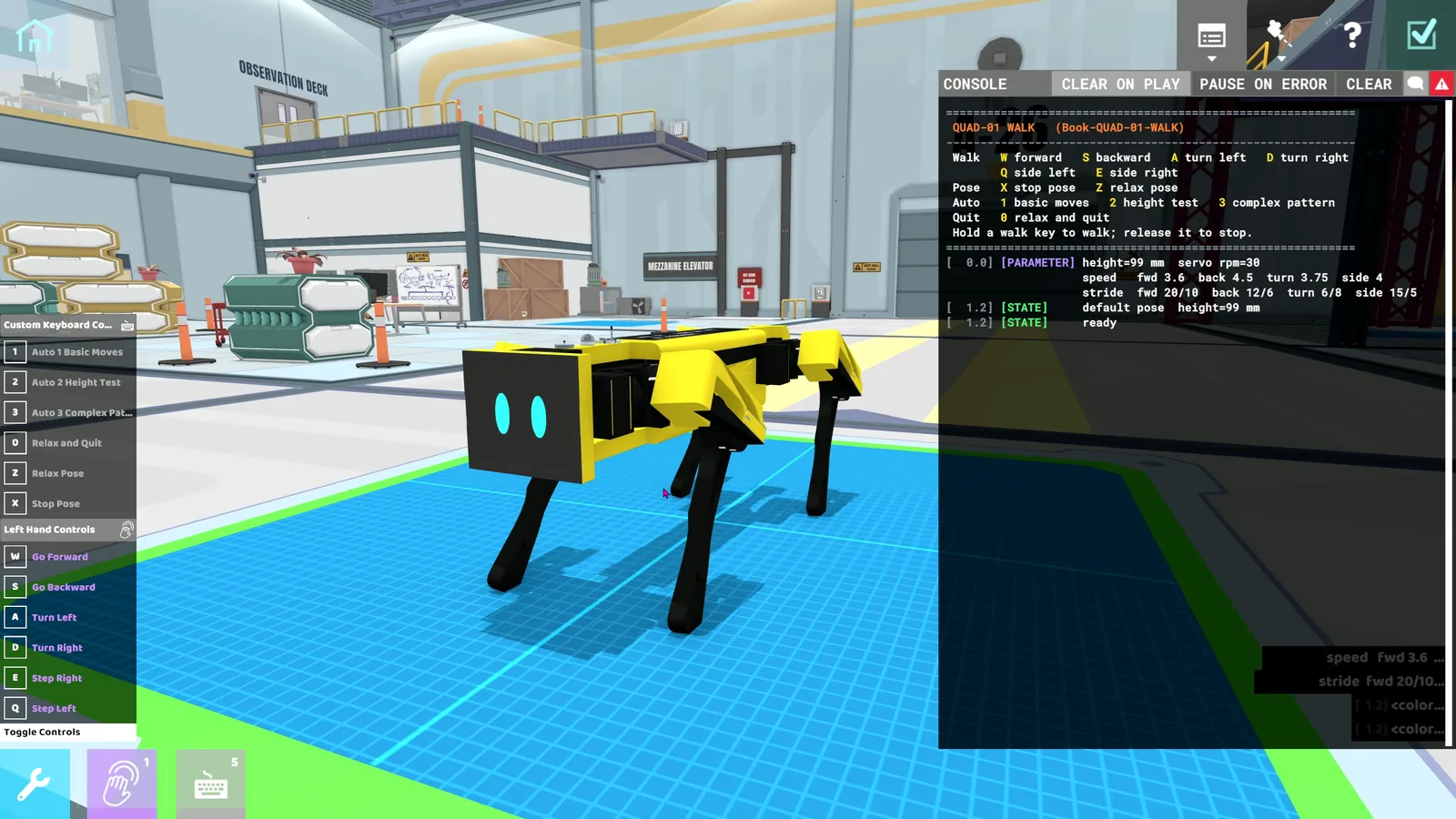
The walking model: hold a key to walk. Forward, back, turn in place, side-step, and auto modes 1–3
Change a four-legged robot's gait and posture in RoboCo and see how walking works

New Print · ebook (Korean edition)
Physical AI with RoboCo · QUAD-01 · WALK
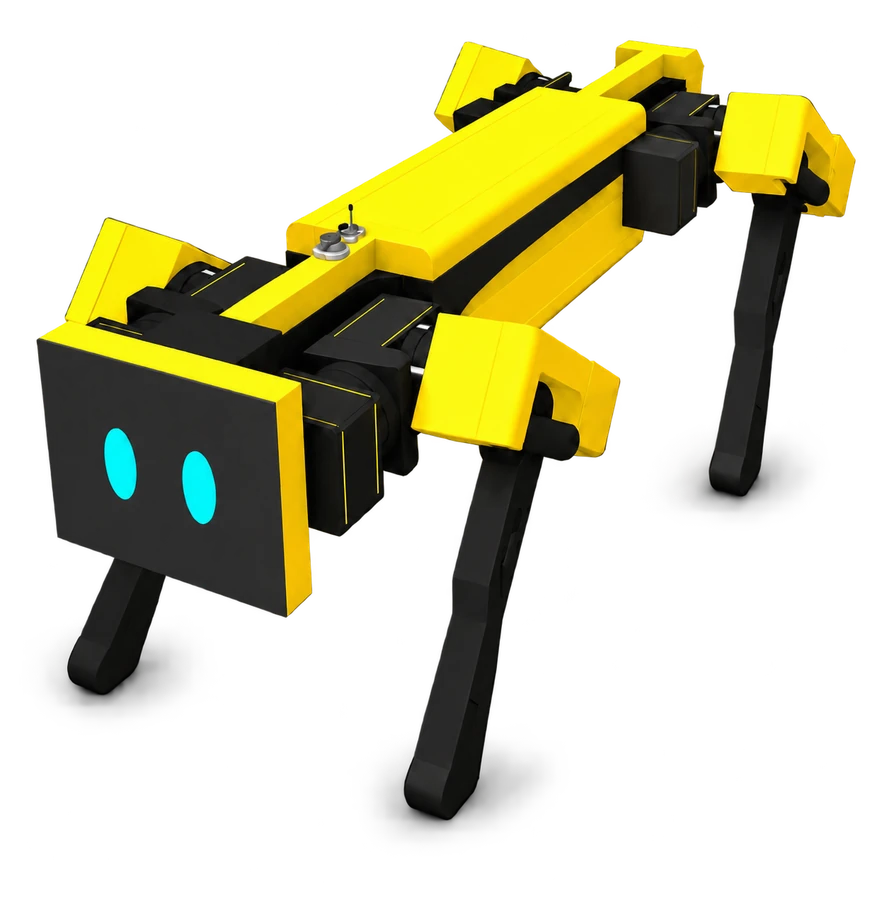
A yellow body on four black legs. While you hold W, the quadruped in RoboCo lifts its diagonal legs in turn and walks forward; let go, and it settles back onto all four feet. Press a number key and the same robot sits and waves, stretches, or holds a handstand.
The book has you walk the robot first, then trace that step back one layer at a time: the gait sets a foot target for each leg, IK turns each target into three joint angles, and twelve ServoMotors make the motion. You change one value, walk again under the same conditions, and when the robot falls, you narrow down which layer to check, in order.
Hands-on quadruped practice in RoboCo's virtual world, no robot kit needed
A real run of the WALK model you start in Chapter 1. It walks while a key is held, turns, side-steps, and stops when you let go. The book spends 25 chapters on the structure and values behind that single step.
Which foot lifts first, where it lands, and how the other feet hold up the body. The book starts from three questions a wheeled robot never has to ask.
Walk key → gait → foot path per leg → IK → joint angles → ServoMotor. You read a single step as five layers.
You check joint axes, turning direction, and left-right mirroring on one leg mounted on a stand, then fix a leg that turns the wrong way.
Model and start file → Port → joint direction → coordinates → IK and joint limits → foot path. You use the console log to narrow it down, fix one condition, and walk again.
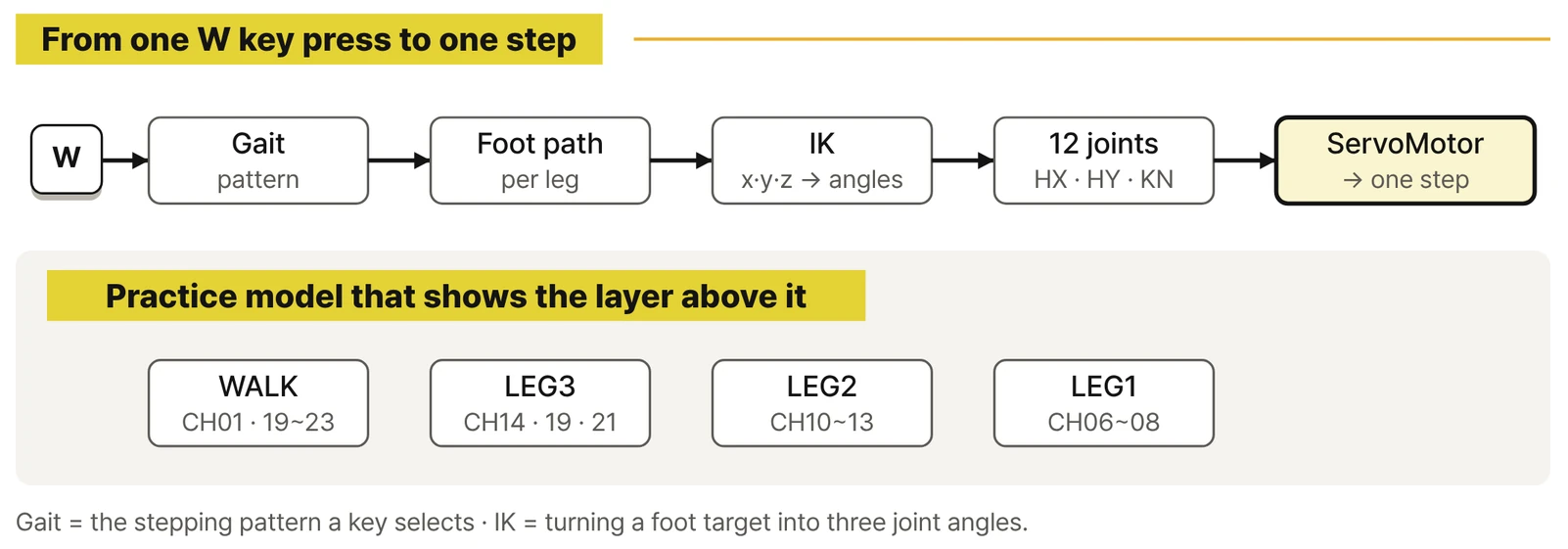
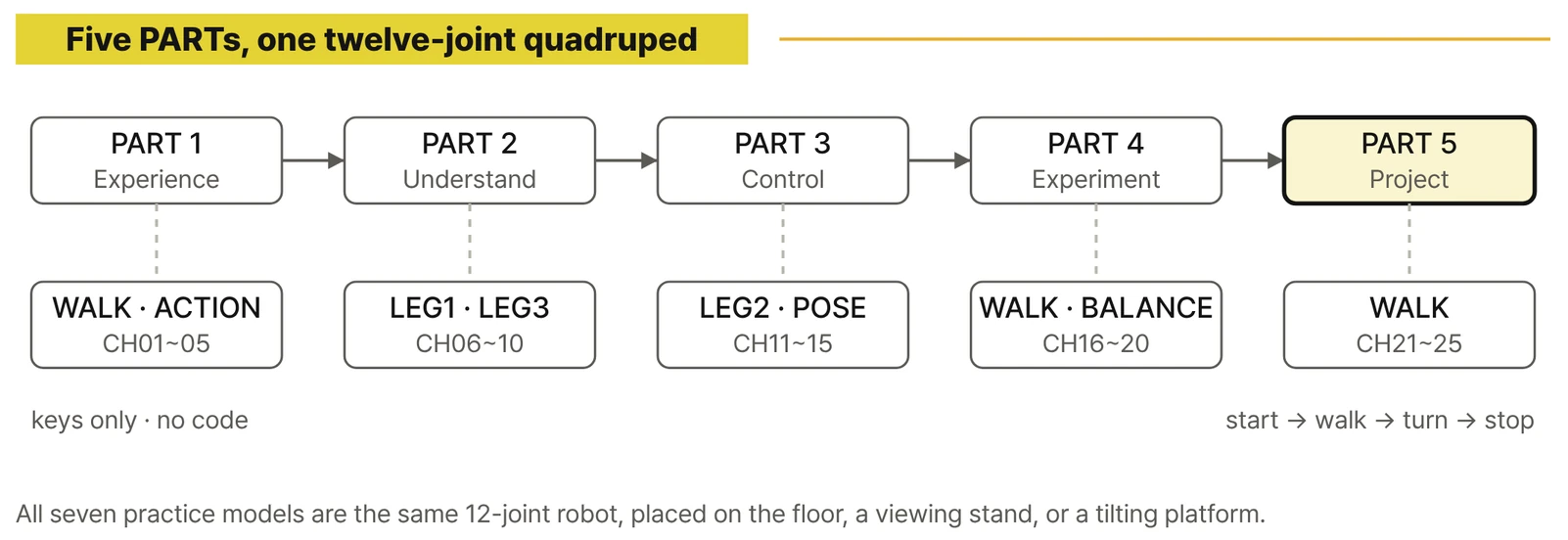
There is one robot: a quadruped with three joints per leg, twelve ServoMotors in all. It is set up as seven practice models: standing on the floor, hung on a viewing stand, or placed on a tilting test platform. There are eight start files in total (BALANCE needs one for the robot and one for the platform).
The walking model: hold a key to walk. Forward, back, turn in place, side-step, and auto modes 1–3
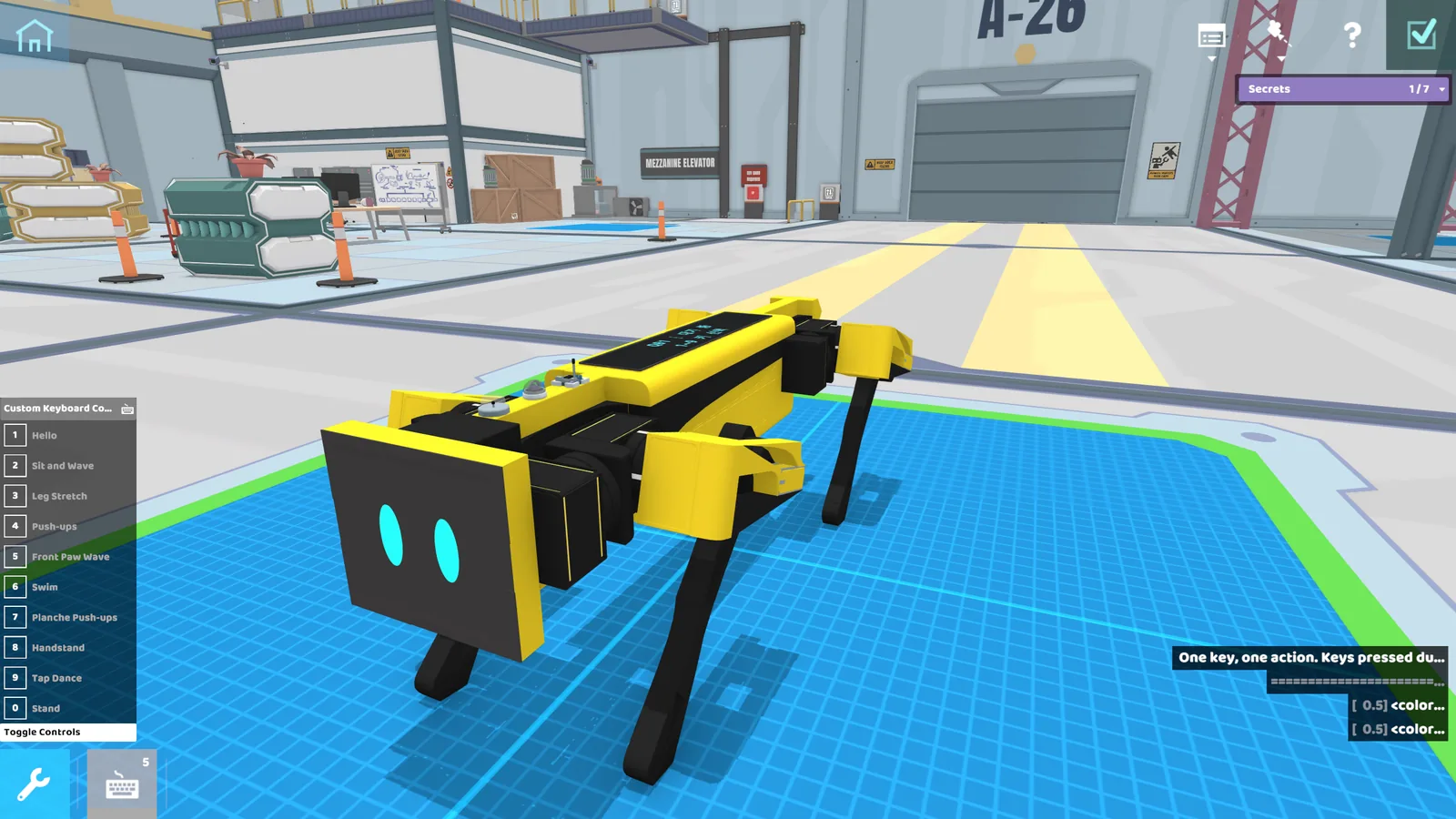
One number key, one performance: from a greeting and a stretch to a handstand and a tap dance
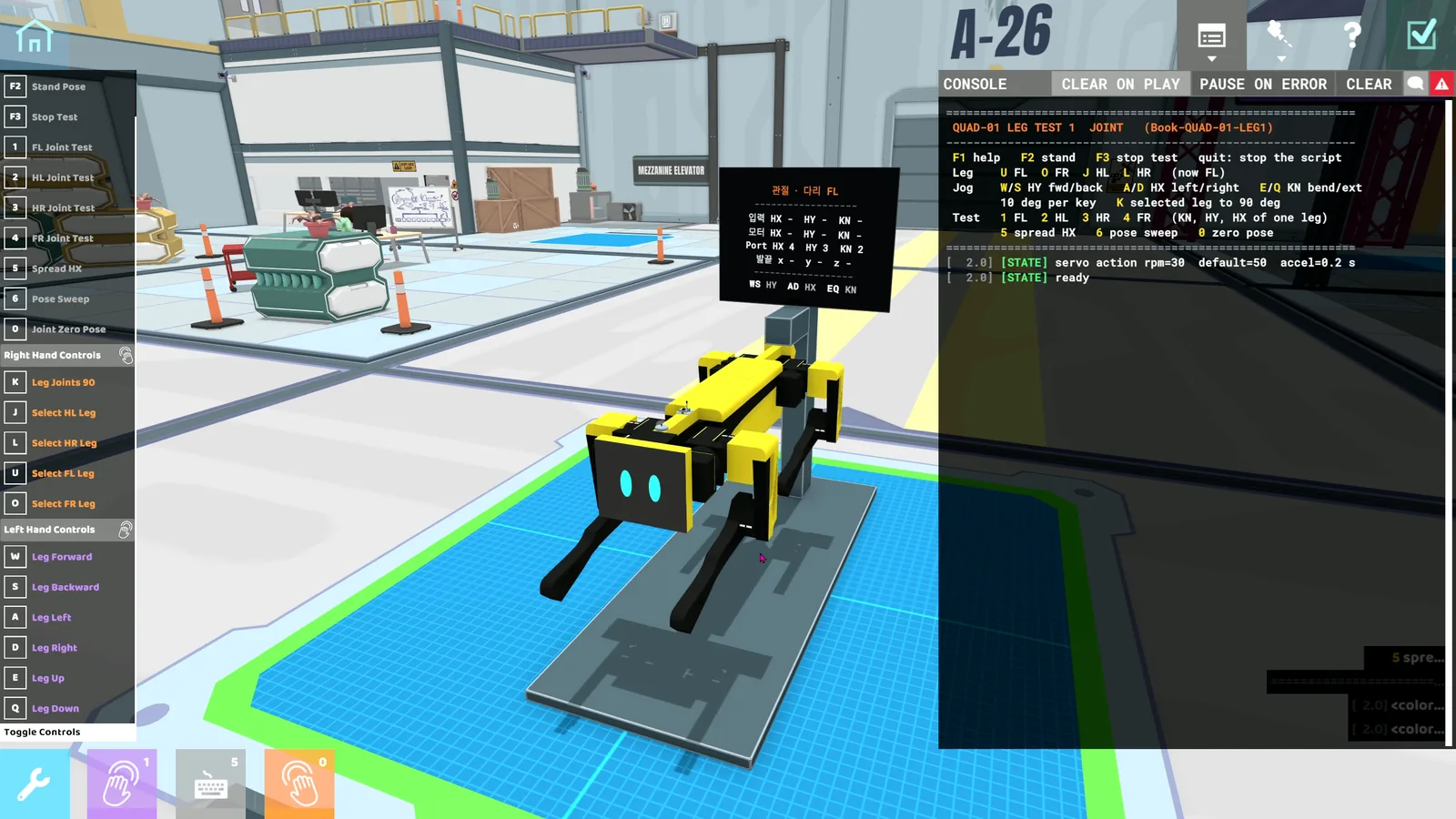
Robot on a stand, one joint at a time. See the HX, HY and KN axes and their Ports on screen
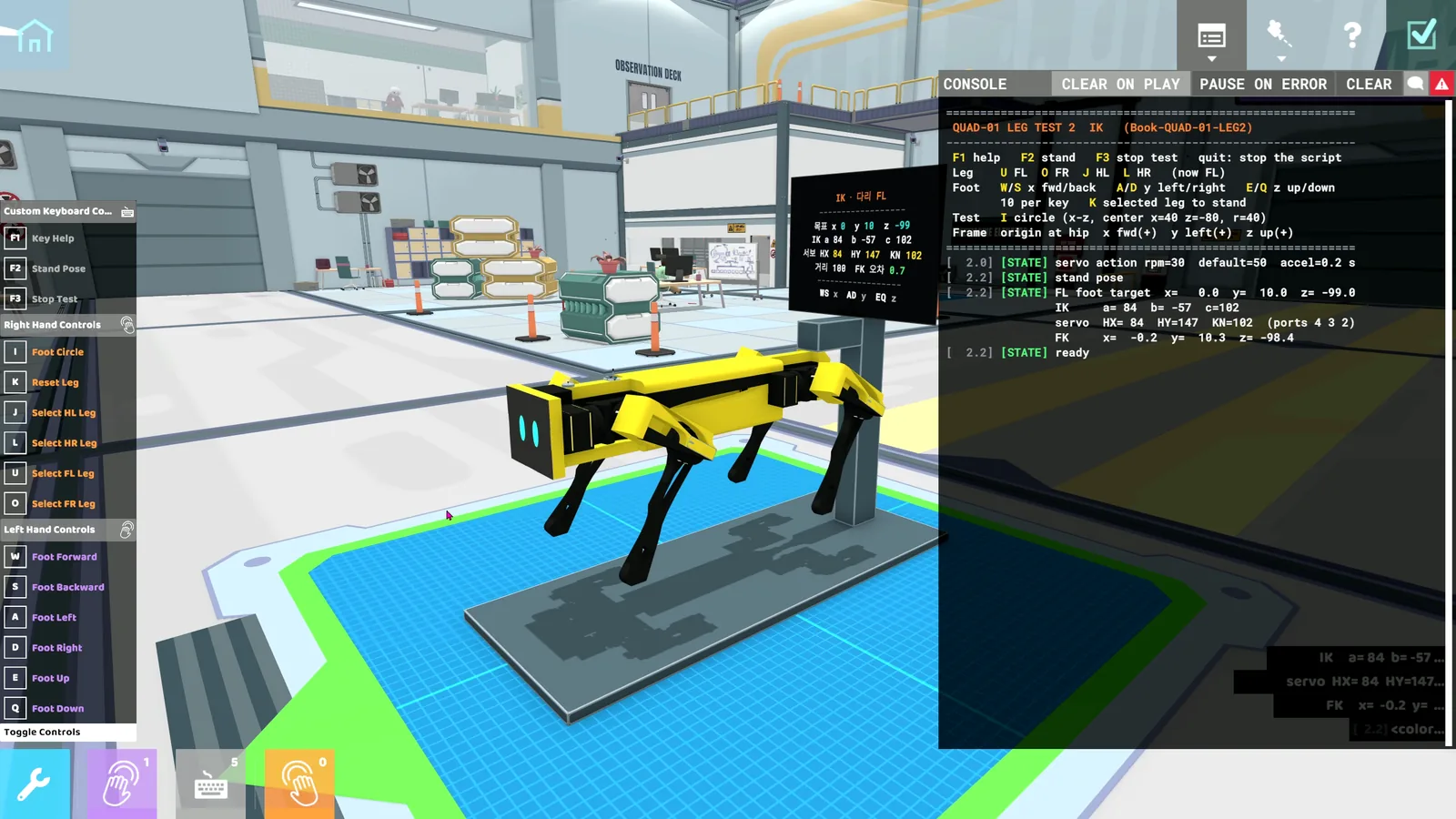
Move a foot target in x·y·z and IK works out three joint angles; FK checks the result
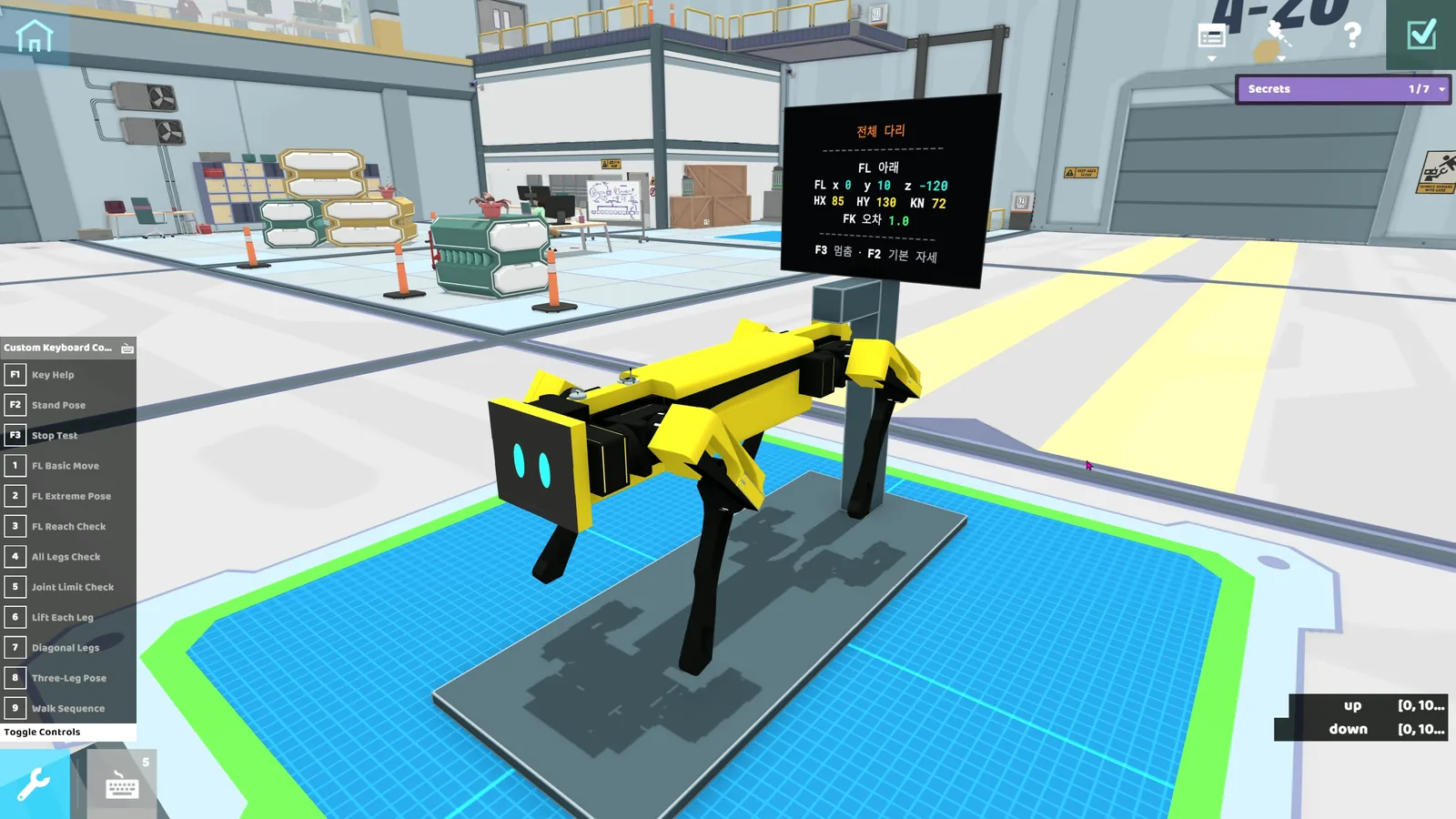
All four legs together: reach, joint limits, lifting one leg, diagonal pairs, a three-leg stance
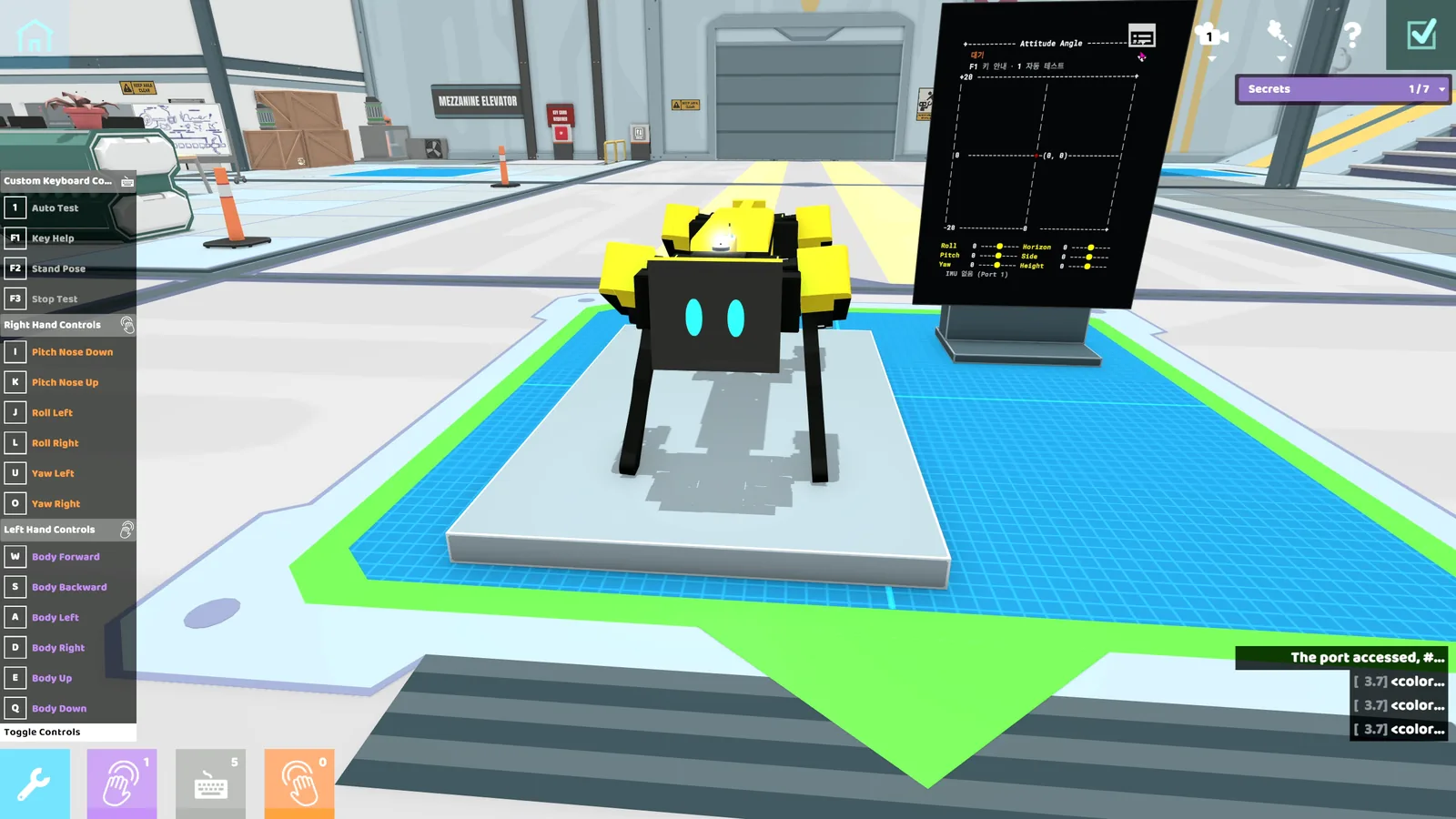
Feet stay planted while the body shifts and tilts: x·y·z plus roll, pitch and yaw
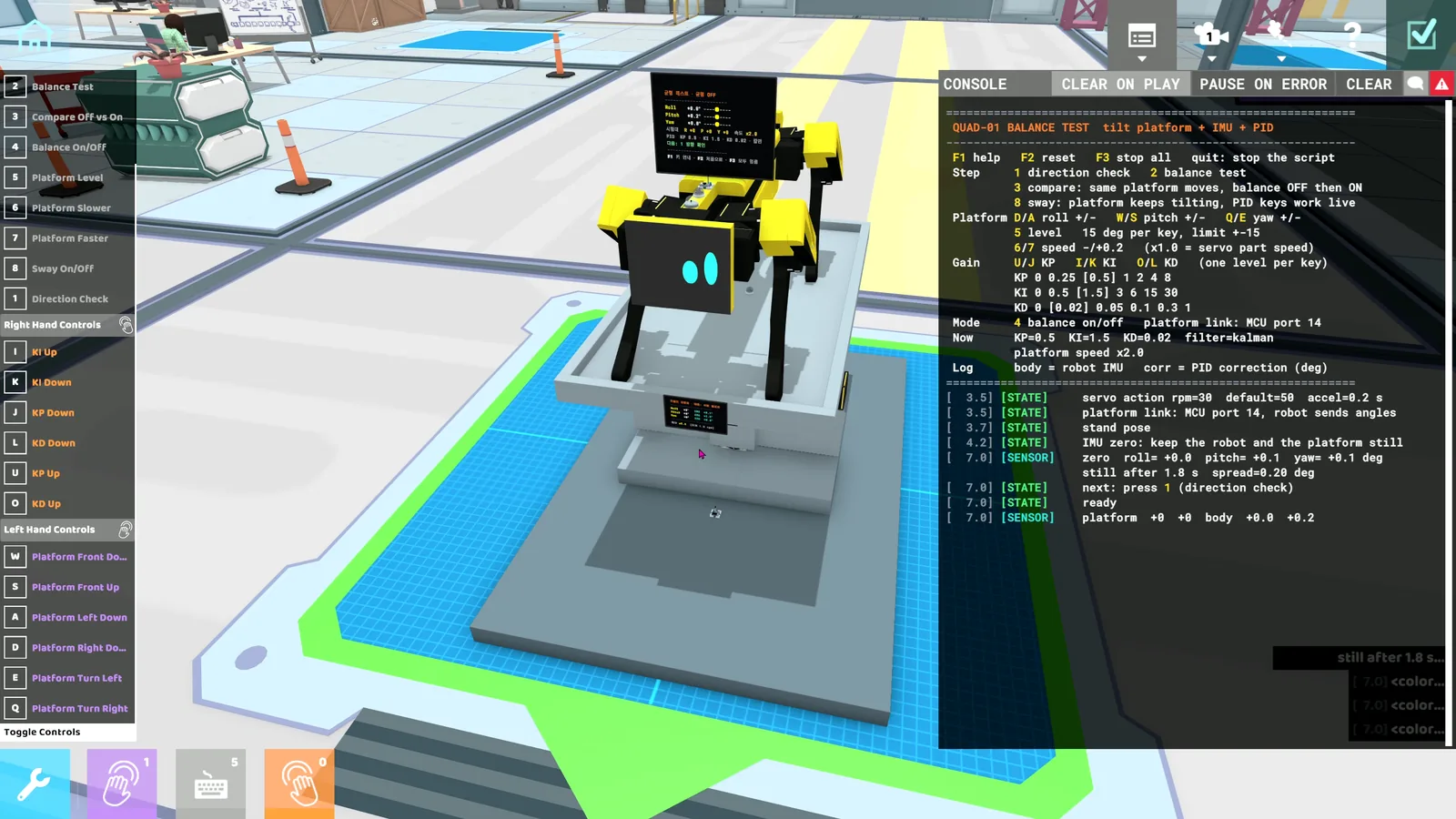
Balance on a tilting test platform with an IMU and PID; two Microcontrollers, robot and platform
[INPUT], [STATE], and [JOINT].This is the entry book for the QUAD track. You don't need any wheeled-robot experience: you start from scratch with this one quadruped and widen your control step by step, from one joint → one leg → four legs → coordinates → IK → posture → gait.
No code yet: just WALK's direction keys and ACTION's number keys. First steps; stand, sit, and stretch; six direction keys and auto modes 1–3; walk, turn, and stop; free play. CH01–05
On one leg mounted on a stand, see the three degrees of freedom and joint axes; then map four legs to twelve ServoMotors, left-right mirroring, the control layers from servo to gait, and the coordinate frame. CH06–10
Move a foot target, let IK compute the leg angles, compare the computed and actual pose, catch unreachable targets in advance, and change the posture of all four legs and the body together. CH11–15
Change body height, tilt and turn, transition speed, the foot paths of standing and moving legs, and stride, speed, and gait cycle, one at a time. The IMU and PID tilting-platform exercise is optional. CH16–20
Build the gait cycle and leg order, walk forward and back, turn left and right, get a fallen robot walking again, then repeat the final mission and record its completion rate. CH21–25
The last chapter comes back to the same W, A, D, and X keys you started with. You fill in a mission card with a start line and a target zone first, then run it several times under the same conditions and record whether the robot walked the whole way, stayed on its feet, and held its stop pose inside the zone. From those records you pick one problem, such as wobbling right after a turn, change one value, and compare again.
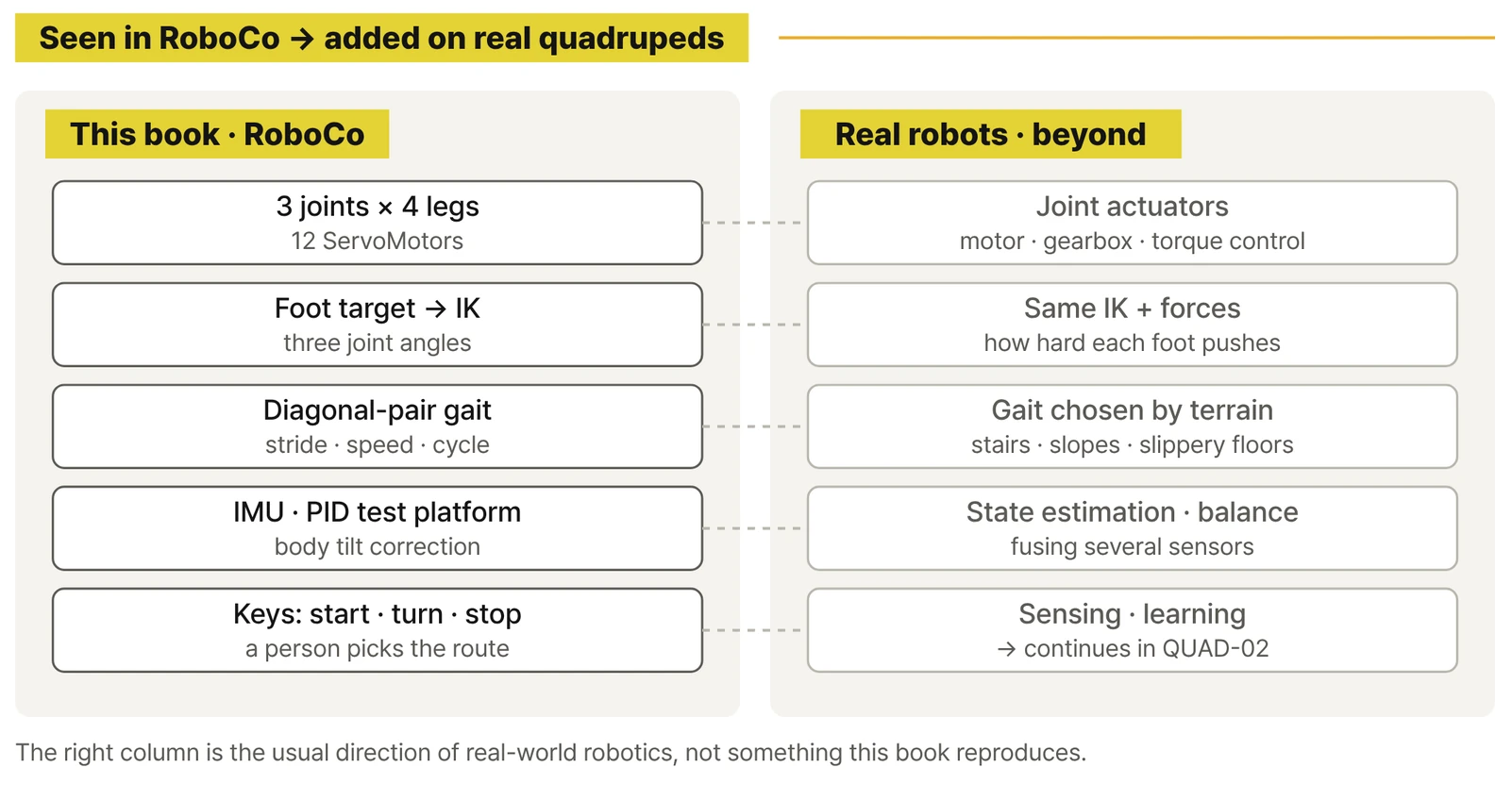
The book covers only what you can check inside RoboCo. This section looks at the question that comes after you close it: how does this experience connect to real quadruped robots? Use it to judge how far the book will take you before you buy.
Wheels are fast and efficient on flat floors. Where the ground breaks up or gets rough (stairs, curbs, gravel), legs that can lift a foot and set it down somewhere else have the advantage. That is why quadrupeds keep finding work in places built for people, such as facility inspection, patrols, and research platforms. The price is that a legged robot has to decide at every moment which feet hold up the body, so there is far more to control than on a wheeled robot. That is why this book starts at the twelve joints.
The free ZIP Book_Q01_Robot contains eight start files and Q01_Lib, the author's teaching library (55 Python files). Its folders follow the same layers as the book.
| Folder | What it does | In the book |
|---|---|---|
core/ | IK, servo commands, the Port table, key input, console log, TextScreen, IMU | Throughout PARTs 2 and 3 |
walk/ · auto/ | Gait (stride, phase speed), walk keys, auto modes 1–3 | CH01, 03, 19–25 |
action/ | Number-key performances and the screen state flow | CH02, 05, 18 |
leg1_joint/ · leg2_ik/ · leg3_combined/ | One joint → foot coordinates → four-leg tests | CH06–14, 19, 21 |
body_pose/ | Body x·y·z and roll, pitch, yaw | CH15–18 |
balance_test/ | IMU filter, PID, the tilting platform and its link | CH17, 20 |
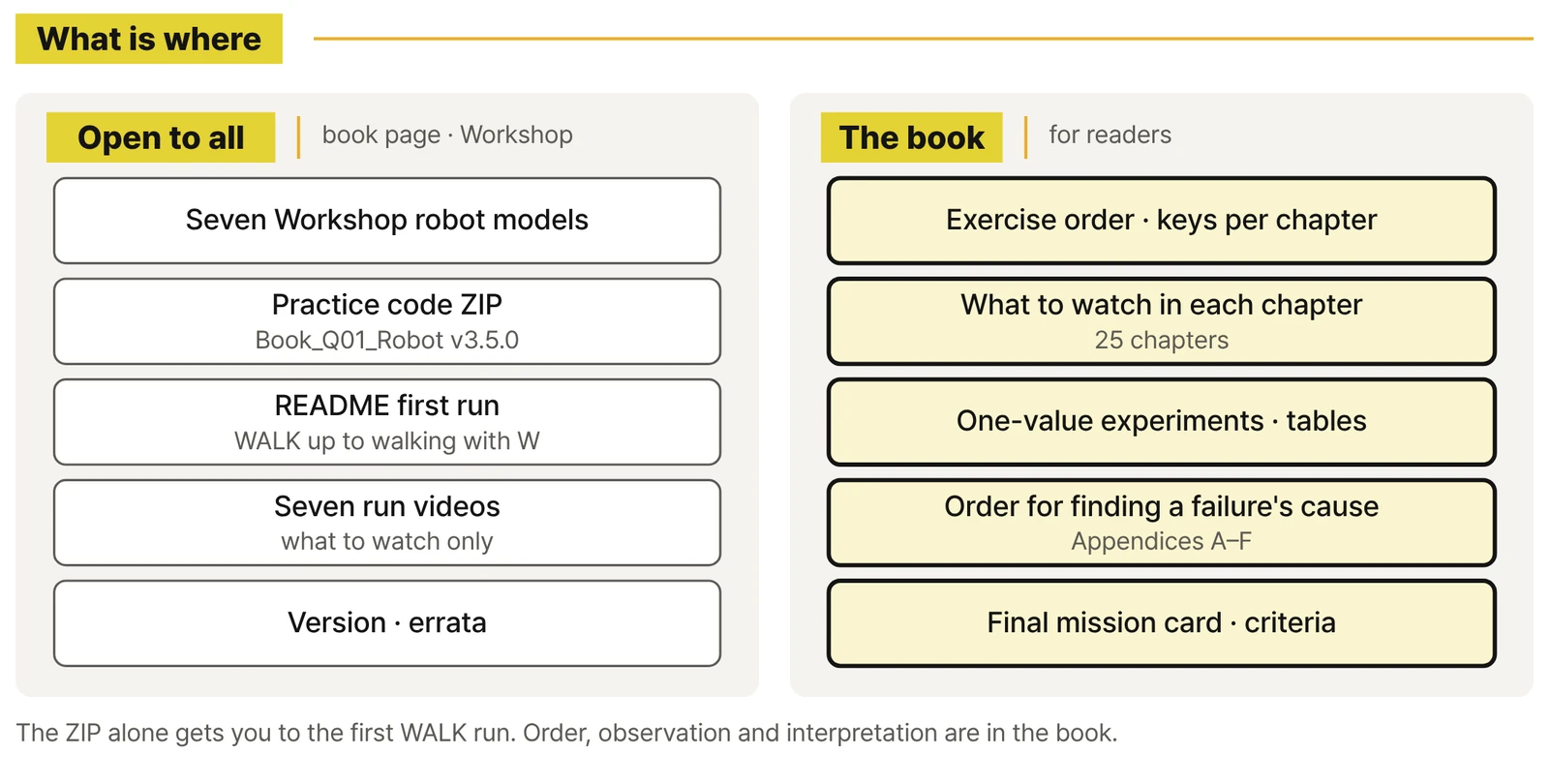
The keys and default values are right there in the code. What the code doesn't contain is the order to run things in, what to watch, which value to change and by how much, what to compare it with, and how to read the result. That is the book's text and appendices.
Autonomous walking, where the robot sees obstacles with sensors and chooses its own gait, and learning-based decisions are in QUAD-02. Walking over to pick up and move objects with a robot arm is in QUAD-03. Real hardware issues such as wiring, power, heat, and communication delay aren't covered. QUAD-01 focuses on the ground all of those stand on: how twelve joint commands become one step.
CONTROL PARAMETERS in the start files and the Q01_Lib/core and walk code, and change the gait yourself.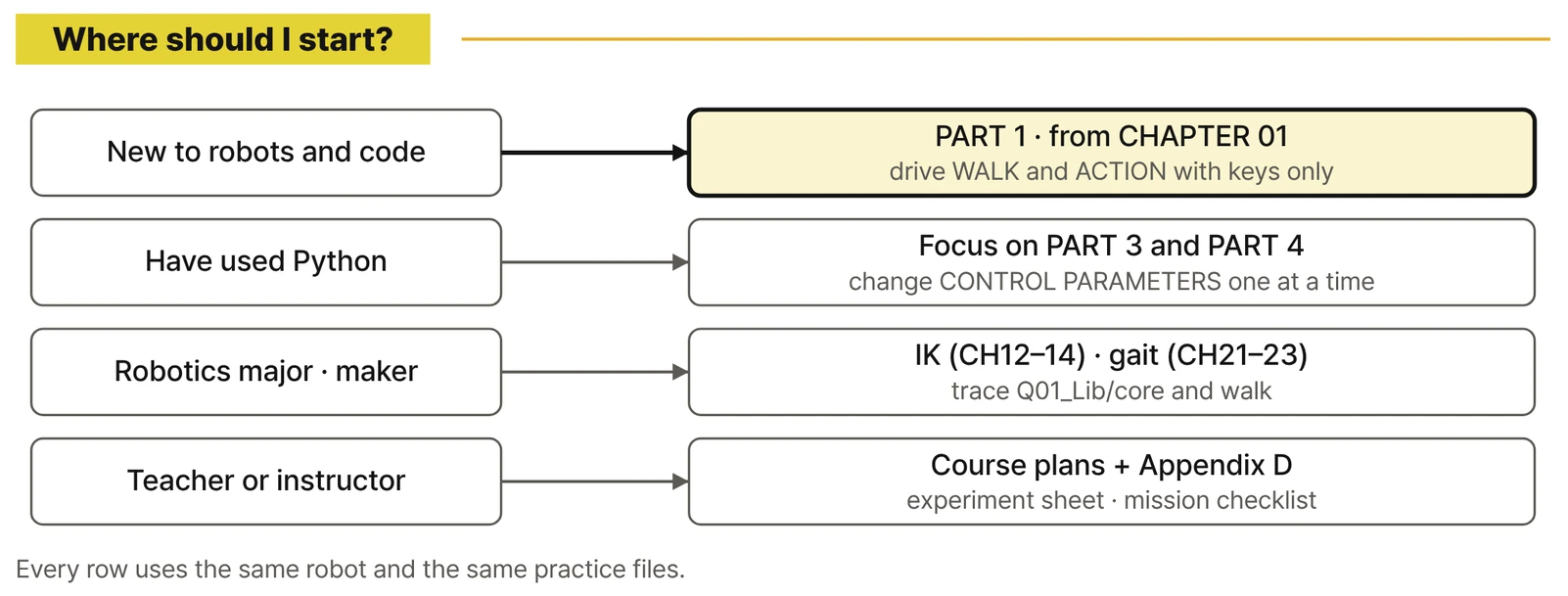
Setup and first run; for all 25 chapters, the exercise order, what to watch, one-value experiments, comparison tables, and the order for finding a failure's cause; the final mission card; Appendices A–F (connections, key maps, IK limit sheet, experiment sheets, gait troubleshooting, terms and units).
The code ZIP v3.5.0 with eight start files and Q01_Lib, plus the guide to the seven Steam Workshop robot models, all on the practice files page with checksums.
Motion a printed page can't show: runs of all seven practice models with what to watch, web-only challenges, versions, and errata.
| Type | Item | Notes |
|---|---|---|
| Required | RoboCo on Steam | Load the robots in Sandbox and run them in Live Mode. |
| Required | Seven practice robot models | Subscribe on Steam Workshop; see the practice files page |
| Required | Practice code ZIP | Book_Q01_Robot_release_v3.5.0_en.zip (English comments): download |
| Not needed | A separate Python install | Scripts run on RoboCo's built-in Python. |
| Optional | A code editor | For changing CONTROL PARAMETERS in the start files. |
Check RoboCo's Steam page for current OS support, system requirements, languages, and price before you buy. The game build the exercises were checked on, and compatibility notes, are recorded under verification status on the practice files page.
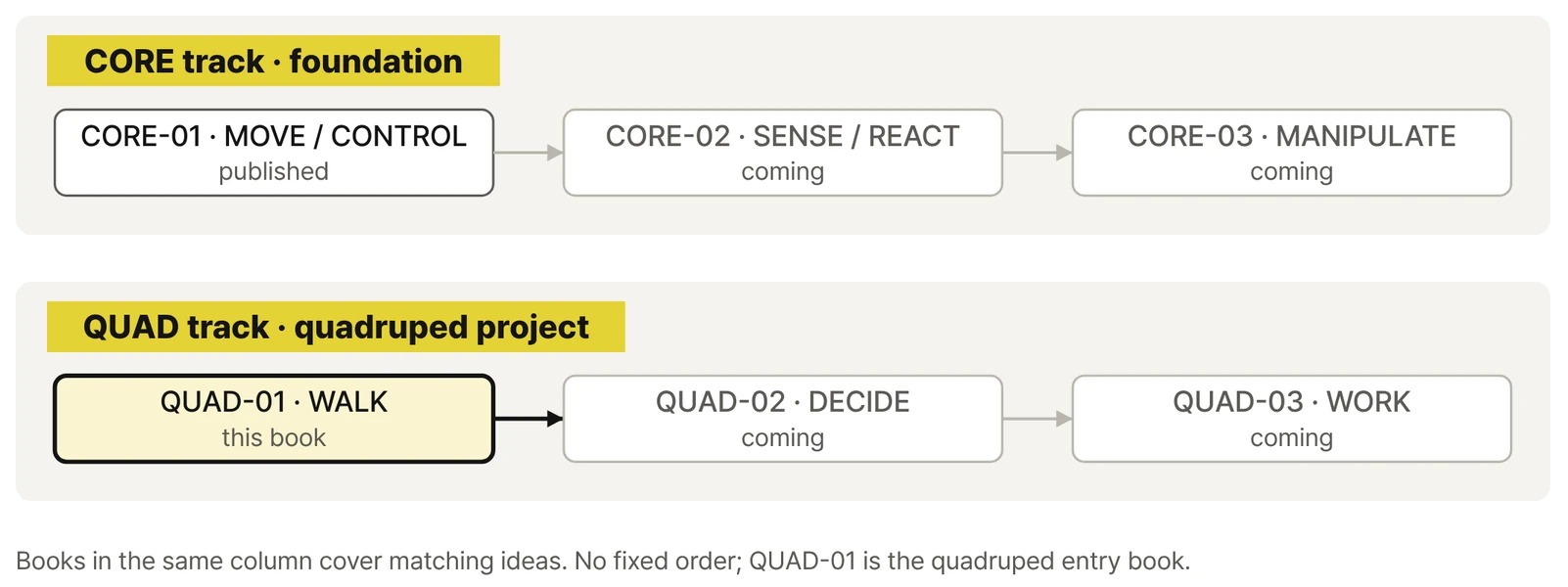
QUAD-01 is the entry book for the quadruped track, and you can start it without reading any other volume. The series splits into a CORE path that builds the foundation (MOVE → SENSE/REACT → MANIPULATE) and a QUAD path that grows the quadruped (WALK → DECIDE → WORK). There's no required order for the six books.
| Book | Capability | What it covers | Status |
|---|---|---|---|
| CORE-01 | MOVE / CONTROL | Driving a four-wheel robot with independent drive and steering | Published |
| CORE-02 | SENSE / REACT | Sensor input, state changes, reactions, feedback | Coming soon |
| CORE-03 | MANIPULATE | Picking up, moving, and placing with a mobile robot arm | Coming soon |
| QUAD-01 | WALK | Joints, foot coordinates, IK, posture, and gait of a twelve-joint quadruped | This book · Published |
| QUAD-02 | DECIDE | Choosing actions from sensors and state; rule-based vs. learning-based | Coming soon |
| QUAD-03 | WORK | Walking over to pick things up and move them | Coming soon |
| Title | Learning Physical AI with RoboCo: Robot Structure and Gait Control (Korean edition) |
|---|---|
| Subtitle | Change a four-legged robot's gait and posture in RoboCo and see how walking works |
| Publisher | PUBPLE |
| Series | Physical AI with RoboCo · QUAD-01 (WALK) |
| Author | Ronnie Kim |
| Language | Korean (practice code also available with English comments) |
| Platform | RoboCo (Steam) · seven Steam Workshop practice models |
| Technical basis | Book_Q01_Robot release v3.5.0 (Python code v3.4.9) · RoboCo Python API 0.3.1 docs |
| Format | Print · ebook. Where to buy |
First you watch it walk. Then you split a step into layers and find out why. Finally you change one value, walk again under the same conditions, and compare. The same method carries straight on to a quadruped that decides with sensors and one that walks over to do a job.